 Karak
Karak multiasset restaking and the OpenGDP rebrand
Karak connects supported crypto assets to operator vaults that provide economic security for services through restaking. Depositors supply collateral through vaults. In V2, allocating a vault to a service subjects its collateral to that service's rules, including potential losses if the operator breaches them. Its multiasset design includes token-based vaults, a native-restaking implementation and building blocks for liquid restaking tokens (LRTs). The project rebranded as OpenGDP, while its newer landing page lists V1 staking, V2 staking and K2 bridge access as legacy. The vault version governs a position's accounting, while the operator determines service participation. The asset's own structure adds separate dependencies.
Multiasset collateral backs service obligations
Within an approved vault, supported collateral can back the obligations that an operator accepts for a Distributed Secure Service, or DSS. Liquid staking tokens represent positions in an underlying staking system, while liquid restaking tokens add another restaking arrangement and stablecoins bring dependencies on their own issuer or backing mechanism to the collateral pool. Multiasset support gives services more than one source of collateral. Each service determines which assets support its security requirements. A basket of tokens retains the obligations attached to the operator and the risks within each asset.
Legacy staking and vault designs carry different dependencies
The position's version and implementation determine its accounting and exit conditions, while the legacy K2 interface addresses eligibility for existing withdrawals. Some options operate at different layers: an LRT wrapper can manage positions in operator vaults, and a custom implementation can change how a vault handles its asset.
| Vault or interface | Position or function | Access or exit condition |
|---|---|---|
| V1 token vault | Allowlisted ERC-20 deposits through VaultSupervisor | DelegationSupervisor governs the withdrawal delay |
| V2 default token vault | ERC-4626-based shares attached to an operator | Redemption follows the vault's withdrawal queue |
| NativeVault | Native Ethereum validator restaking | Native balance accounting governs withdrawal eligibility |
| LRT wrapper | Managed positions across operator vaults | The wrapper must handle underlying withdrawal queues |
| Custom vault implementation | Asset handling through the base vault interface | Core must allowlist the asset and implementation |
| K2 Claims | Available assets associated with K2 withdrawals | Eligibility uses the wallet associated with those withdrawals |
| Wrapper exits inherit underlying vault constraints; K2 claim eligibility uses the wallet associated with the withdrawals. | ||
Choosing between direct token restaking and native restaking changes the asset-handling mechanism. K2 claim eligibility concerns a separate legacy withdrawal position.
Does depositing in a V2 token vault choose an operator?
Depositing into a V2 operator vault delegates that deposit to the vault's operator. The vault's configuration identifies its operator. The operator then chooses the DSSs that it serves and the vaults that it allocates to them. Depositing and allocating a vault to a service describe different decisions, even though both contribute to the same security arrangement.
Vault shares and delegated assets
The default token vault uses ERC-4626-based accounting to represent a depositor's claim through vault shares, which measure a claim on the vault's assets rather than an amount of the underlying token. A share's asset entitlement follows the vault's accounting as its underlying balance changes.
Operator commitments
The operator performs the work that its chosen service requires, while depositors supply collateral through its vault. Service participation connects those operational commitments to the enforcement rights that the DSS holds over allocated assets.
Allocation through Core
Core coordinates operator registration and vault allocation. Its records identify which vaults an operator has staked to a particular DSS, linking the selected collateral to the service that can enforce its obligations.
Rules set by each service
A DSS can reject an allocation through its hooks. Its own task rules then determine how an accepted operator must perform, alongside the protocol rules that govern its slashing rights.
Native restaking follows validator balances
The documented V2 native-restaking implementation uses NativeVault to account for Ethereum validator stake through withdrawal-credential and balance proofs. Its entry mechanism follows validator accounting, with dependencies that differ from transferring an issued ERC-20 token.
Balance snapshots account for changes in the stake that the native position represents. The implementation validates proofs for active validators and adjusts shares as balances change, reflecting gains or losses in the recorded stake.
Native accounting also distinguishes total restaked value from ETH that the node can release. Withdrawal eligibility depends on both the position's asset entitlement and credited withdrawable ETH.
In the 2024 V2 NativeVault implementation, ordinary token deposits and share transfers revert. Its shares record the native position without supplying the transfer functionality of a standard tokenized vault, so an integration needs the native-specific entry and exit methods.
Rewards come from the service
In V2, DSSs distribute rewards outside the Core contracts. A service or operator therefore supplies the reward mechanism that a position uses. An LRT manager needs a way to claim those rewards on behalf of depositors. Vault shares record the underlying position; they don't establish a universal payout schedule. The service's actual distribution rules govern what it pays, who receives it and how a reward becomes claimable.
Slashing connects operator performance to collateral loss
If an operator breaches a DSS's requirements, the service can request slashing against vaults that the operator has allocated to it. Slashing reduces affected collateral under the protocol's enforcement process.
V2's slashing design separates a slash request from its finalization. A veto committee can reject the request during the review window; an eligible request that isn't vetoed can then proceed to collateral enforcement. The committee's ability to veto doesn't promise that every disputed request will receive a veto.
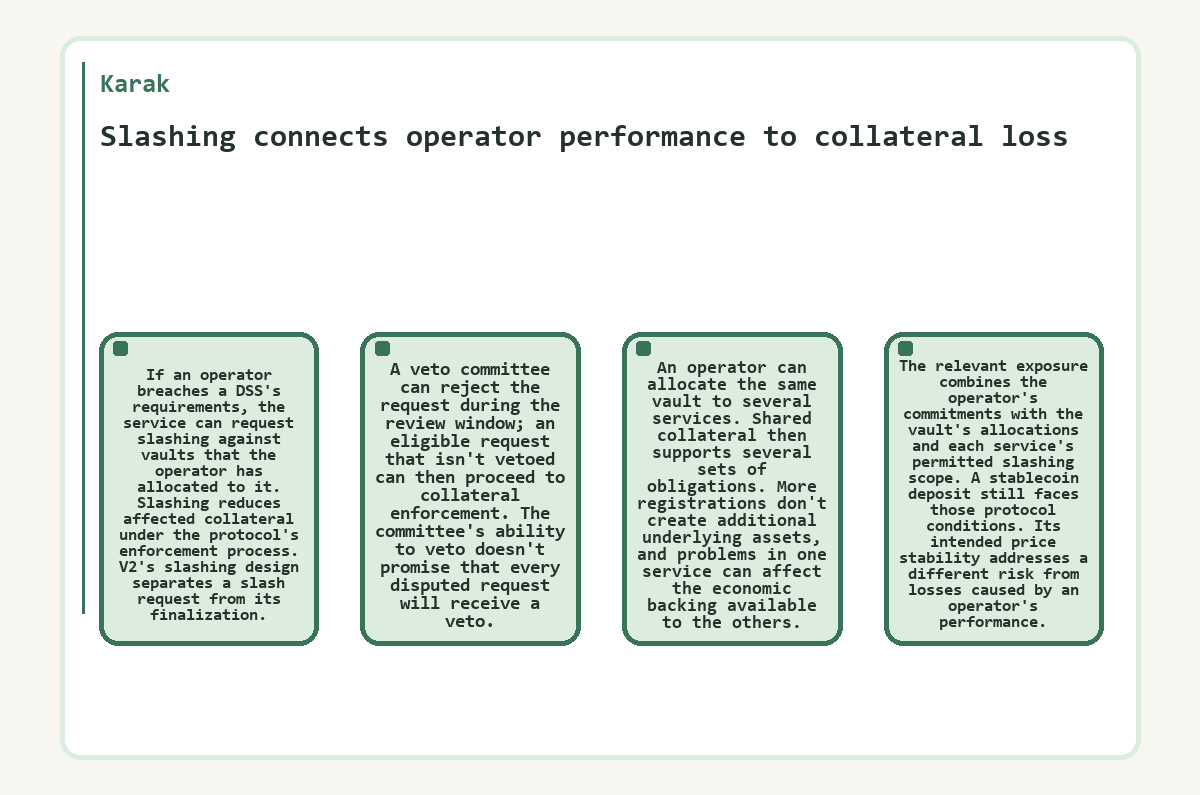
An operator can allocate the same vault to several services. Shared collateral then supports several sets of obligations. More registrations don't create additional underlying assets, and problems in one service can affect the economic backing available to the others.
The relevant exposure combines the operator's commitments with the vault's allocations and each service's permitted slashing scope. A stablecoin deposit still faces those protocol conditions. Its intended price stability addresses a different risk from losses caused by an operator's performance.
Withdrawal timing follows the selected contract
Once a position enters a withdrawal queue, the contract's delay and completion rules govern its exit. The documented default V2 token vault specifies a nine-day minimum withdrawal delay. That interval belongs to this implementation; it doesn't define every native, wrapped or legacy exit.
V1 uses a separate withdrawal supervisor with a readable delay parameter. The default V2 vault has its own redemption functions. Karak's recommended token-based LRT design adds a queue that must accommodate the underlying vault's timing. Starting a request establishes a pending withdrawal, and completing redemption releases the assets under the applicable rules. A transfer out of restaking and a K2 asset claim concern different positions.
Asset approvals and chain support constrain access
Token restaking requires an accepted asset and an appropriate vault on the selected chain, with authorization for the vault to transfer the tokens. Core's allowlisting controls which assets and custom implementations it accepts. The default vault's ability to handle ERC-20 tokens doesn't mean that every ERC-20 token has an enabled deposit route. The V2 staking interface displays Arbitrum as a chain selection, within that interface's context. Other chains and assets require their own supported vaults. A token balance on one network doesn't automatically become a balance in a vault on another network.
Approval permits token movement; the deposit creates the vault position. The documented default V2 token vault has a deposit method with a minimum-share-output parameter. That method reverts if it would mint fewer shares than the chosen minimum. Network transaction fees depend on the chain and transaction conditions. V1's gasless approval method addresses token authorization, while depositing remains a transaction.
OpenGDP retains V1 and V2 as legacy staking interfaces
The newer OpenGDP landing page lists V1 staking, V2 staking and K2 bridge access as legacy, alongside a coming-soon message for an Open World Model Network. Karak's rebrand to OpenGDP was announced on November 16, 2025. At that transition, existing user functions remained unchanged apart from branding and addresses. The rebrand described OpenGDP as a Layer 1 designed for tokenizing assets, services and data. Its stated functions included trading and settlement, plus coordination for payments and clearing. The K2 destination now presents claims for available assets associated with K2 withdrawals, with eligibility tied to the connected wallet.
An approved V1-to-V2 migration redeems underlying assets and issues destination-vault shares. The brand change doesn't perform that contract operation. Existing share ownership, pending withdrawals and K2 claim eligibility continue to follow their respective contracts and records.
Shared security supports services and specialized networks
When a service needs operators to perform verifiable work, restaking supplies collateral that can give those obligations an economic consequence. Service categories include data availability, bridges and oracles. They consume security through their own architectures, so their task requirements and enforcement rules remain part of the service design.
The Karak Network Stack, or KNS, was designed to combine specialized blockchain networks with shared security, bringing customizable networks for financial markets and other applications into a broader architecture that incorporates operator security.
Shared security addresses the capital and operator commitments that support a network. The wider design also needs execution rules and application infrastructure for functions such as tokenization, trading or settlement.
Liquid wrappers add another management layer
For liquid staking tokens and other ERC-20 tokens, Karak's recommended LRT design uses a wrapper vault that accepts deposits and allocates them across operator vaults. Its receipt token adds a contract layer whose exposure follows both the underlying services and the wrapper's management choices. In this design, an administrator can rebalance allocations, withdraw assets and harvest rewards for depositors. Those powers make the manager's permissions relevant to the resulting exposure. A wrapper must also accommodate asynchronous withdrawals. Its own queue handles requests while the underlying operator vaults apply their exit rules. Reward collection requires explicit integration with the service or operator. Issuing a receipt token leaves the underlying vault's withdrawal delay in place.
Custom vaults provide another extension point for asset handling. They must implement the base vault interface and obtain the required asset and implementation approvals in Core. A shared interface supports integration, while the custom code determines its additional behavior. The wrapper's capabilities remain bounded by the vaults and services that it actually uses.
Your questions, answered
Why might the Karak V1-to-V2 migration option be missing?
The migration option appears only when the position's asset and network are enabled in V2. That availability condition applies to the particular position, so another enabled asset doesn't establish compatibility. The migration itself also requires an approved route between vaults that hold the same underlying asset. A general V2 interface doesn't make every V1 position immediately migratable.
Do V1 vault shares keep the same meaning after migration?
V1 and V2 share amounts refer to claims in different vaults. The migration burns the selected old shares, redeems their underlying assets and deposits those assets into the destination vault. That vault mints new shares for the caller. Tokenized V1 shares must first return to the supervisor's internal accounting before migration; the new share count describes the destination position.
Does V2 retain Karak's V1 referral-code system?
V2 mainnet doesn't use V1's invite-code and referral system. Referral-based XP belonged to V1. The original XP program also allowed its rates to change, so neither a referral code nor an old point multiplier establishes a continuing V2 reward rate.
What did the GDP token announcement make available?
The December 4, 2025 announcement introduced a proposed native asset named $GDP, with its design still under research. At that announcement, no $GDP token existed or was available to purchase or claim. The stated security and coordination roles described a proposal whose mechanics could change. The announcement didn't establish a later launch date or executable token-claim process.
Can a dollar-denominated stake display differ from the deposited token balance?
KarakStakeViewer calculates dollar-denominated active stake using token balances and configured asset-price oracles. Its calculation excludes vaults queued for unstaking and tokens queued for withdrawal. The resulting value therefore measures priced active stake, which can differ from a broader deposit total. Asset prices and eligible balances determine the display; a dollar figure doesn't itself represent a withdrawal payment.
Are signatures a substitute for every token approval in V1?
V1's signature-based deposit method requires a token that implements ERC-20 Permit. It uses both the token's permit and a vault-allowance signature that identifies the intended vault and amount. The method also includes a signature deadline. This authorization applies to that supported deposit method; it doesn't establish that all tokens support permit signatures or that submitting an approval completes a deposit.
How do security reviews distinguish token vaults from native restaking?
Published security reviews cover particular versions and components of the restaking protocol. The audit lists distinguish V1.x from V2.x and identify reviews specifically for native restaking. Reports for that implementation concern different code from the default token vault. A custom vault or LRT manager has its own implementation, and each review's component list sets the scope of its findings.